A Rainy-Day Picture Game for Finding Visual Gags
A rainy-day picture game builds playful captions from everyday objects, giving families a simple indoor activity with clear prompts and easy ways to revise.
The common mistake in a rainy-day picture game is to keep asking what an object looks like. That can trap everyone in the same round of visual comparisons and leave little room for a new comic idea. Instead, give the object a small social problem: decide who owns it, what they want, and why the situation is awkward.
Start with a situation
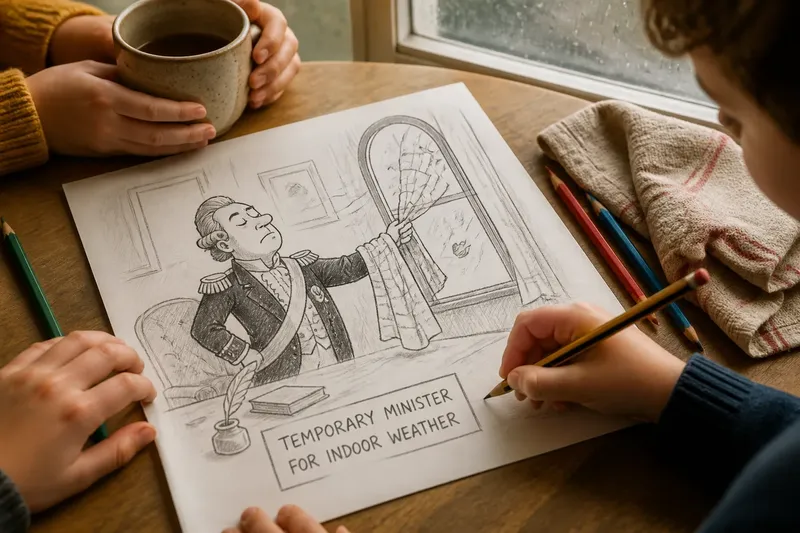
Imagine a family indoors with paper, pencils and a tea towel. They are not trying to turn the towel into another object. They are drawing a character who has been given the wrong responsibility: a royal adviser must keep the palace’s draughty windows closed, but has only a tea towel and no authority over the wind.
That situation can be drawn with a simple figure, a window and the towel. The gag comes from the character’s earnest response to an unmanageable task. The picture need not depend on a surprising resemblance; it can show a familiar human habit, such as pretending a flimsy solution is official policy.
Ask each player to choose a person or creature, a small problem and a response. Keep the problem easy to see. A cat guarding an empty food bowl is clearer than an elaborate story about a cat’s secret past.
Give the character a motive
A motive explains why the character acts as they do. In a short visual joke, it can be as simple as wanting to look important, avoid a chore or protect a snack. Add one visible clue that makes the motive legible: a badge for someone acting officious, a broom for someone avoiding sweeping, or a carefully guarded biscuit.
Try this prompt: “Someone wants ___, but ___ gets in the way.” The player fills both gaps, then draws the moment when the character responds. The answer should be visible in the scene rather than hidden in a long explanation.
For instance, someone wants to avoid watering a plant, but the plant is wilting. The character might solemnly appoint a toy watering can as the “temporary assistant” and leave it beside the pot. The joke is the character’s attempt to shift responsibility, not the outline of the can.
Keep the scene readable
Use a clear setting and a few useful details. A sheet of paper, a pencil and a kitchen table are enough. On a phone, the camera and a basic drawing or markup app can serve the same purpose. Leave out background objects that do not help viewers understand the problem or the response.
Place a short caption below the drawing if the character’s attitude needs words. “Temporary assistant” gives the plant scene a brisk, official tone. A long explanation would take away the pleasure of spotting the character’s evasive logic.
Show the scene before reading the caption aloud. Viewers can first notice the character and the problem, then use the words to sharpen their interpretation. If the picture is unclear, add a visible clue or simplify the action rather than explaining every detail.
Use a quick decision list
Before sharing a drawing, check these points. Each result suggests a specific next move, so revision stays practical rather than turning into a debate about whether a joke is funny.
- Can a viewer name the character? If the figure is unclear, add one identifying detail such as ears, a uniform or a name label; otherwise, keep the drawing uncluttered.
- Can a viewer see the problem? If not, draw the obstacle or its consequence; if the problem is already clear, do not add another prop.
- Is the character’s motive visible? If not, add a clue such as a guarded biscuit or a chore list; if it is visible, move on to the response.
- Does the response reveal the character’s attitude? If not, change the pose or action; if it does, keep that moment as the centre of the scene.
- Does the caption add information? If it merely names what is drawn, replace it with a line that reveals the character’s excuse or ambition; if it adds that point, retain it.
- Is any detail distracting? If a prop does not clarify the problem or motive, remove it; if it helps the viewer read the scene, leave it in.
Work through one round
Say a family starts with a blank page, a pencil and a tea towel. One child chooses a palace adviser as the character, a draughty window as the problem and the wish to appear competent as the motive. They draw the adviser beside the window, holding the towel against a gap while a small pennant on the desk says “Office of Wind Control”.
The group checks the scene. The adviser is recognisable from the sash; the open window shows the problem; and the official pennant gives the character’s ambition a visible form. The first caption, “The adviser closes the window”, only describes the action, so they change it to “Temporary Minister for Indoor Weather”. The new wording makes the character sound grand while the scene shows a modest, ineffective response.
They then decide the desk pennant is unnecessary because the caption already gives the role. Removing it leaves the adviser, towel and window as the main details. The result is not a puzzle about what the towel resembles; it is a compact scene about someone dressing up a minor task as a grand appointment.
What helps the game?
Does the drawing need to be polished?
No. A clear pose and a few recognisable details are enough to show who has a problem and how they respond. A photograph of toys arranged on a table can work too.
How can younger players join in?
Offer a choice of two characters or problems, then let the child select the response. They can dictate a caption or show the action with a simple drawing.
What if the scene feels confusing?
Remove extra details and make the problem visible. If viewers still cannot tell what the character wants, add a clue such as an empty bowl, a chore list or a waiting audience.
Can the game work without captions?
Yes. Use a clear pose or arrange toys to show the character’s response. Add spoken words only if viewers need help understanding the motive.
Change the comic problem
For another round, keep the same paper and pencils but choose a different kind of difficulty. A toy knight might be desperate to impress a dragon while holding a damp sponge as a shield. A very serious pigeon might try to organise crumbs into a neat queue before lunch. Each scene gives the character a motive and lets a visible response reveal their personality.
For a rainy-day picture game, the most useful question is not what an object could impersonate, but what a character might do when ordinary plans go wrong. Choose a clear problem, show the response and trim details that do not help. That leaves viewers with a small human contradiction to recognise, rather than another round of matching shapes.