How Comic Cartoons Moved from Print to Stage
Trace how comic cartoons moved from printed pages into live performance, and see how reproduction, scale and timing changed the way audiences met them.
The common mistake in tracing the comic cartoon from print to stage is to treat its history as one unbroken visual trick. That hides the changes in how audiences encountered it: a printed image could be studied at leisure, while a live comic image had to register across a room and within a performance. The comic cartoon’s history is best understood through those shifts in medium and setting.
Printed pictures circulate
Printed satire and comic imagery appeared in varied forms, including single-sheet prints, illustrated books and periodicals. Their subjects and styles differed, but print offered a way to reproduce an image and make it available beyond the place where it was first made or displayed. A reader could pause, return to a detail, or show the page to someone else.
That circulation did not make every printed joke easy to read. Paper, reproduction methods, page layout and viewing conditions all affected what remained visible. A dense image might reward close attention; a publication seen quickly might favour stronger contrasts and more immediately recognisable forms. These are useful tendencies, not a single rule that governed every cartoon or period.
For example, imagine a periodical editor placing a crowded comic scene beside a short column of text. If the characters’ expressions blur at the page’s printed size, the editor could choose a larger reproduction or a less crowded image; the expected result is that readers can distinguish the main action without losing the surrounding detail. This imagined choice illustrates a practical constraint, not a claim about a particular historical publication.
Newspapers reshape cartoons
As illustrated newspapers and magazines developed, cartoons became part of a regular reading experience. Their formats ranged from topical comment to social observation and visual farce. A cartoon printed alongside news could respond to public events, while other images offered jokes that did not depend on a specific headline.
Reproduction and layout mattered. A cartoon reduced to fit a column could lose a fine expression or a small clue. Captions and labels helped identify a subject, but they could also tie the image closely to its original setting. Once detached from the page, a topical cartoon might be harder to understand because readers no longer saw the surrounding article or knew the event being referenced.
These conditions encouraged cartoonists and editors to consider how an image would appear in print, but they did not dictate one style. A bold, simplified drawing could be legible at a glance; a detailed image could invite a slower reading. The right approach depended on the cartoon’s purpose, its size and its audience.
From page to stage
Comic imagery also met audiences through live entertainment, including popular theatre and variety performance. The relationship between a printed cartoon and a stage joke was not always a direct adaptation. Rather, performers could use visual arrangements familiar from comic pictures: a conspicuous prop, an exaggerated pose, or a situation that became legible through what the audience could see.
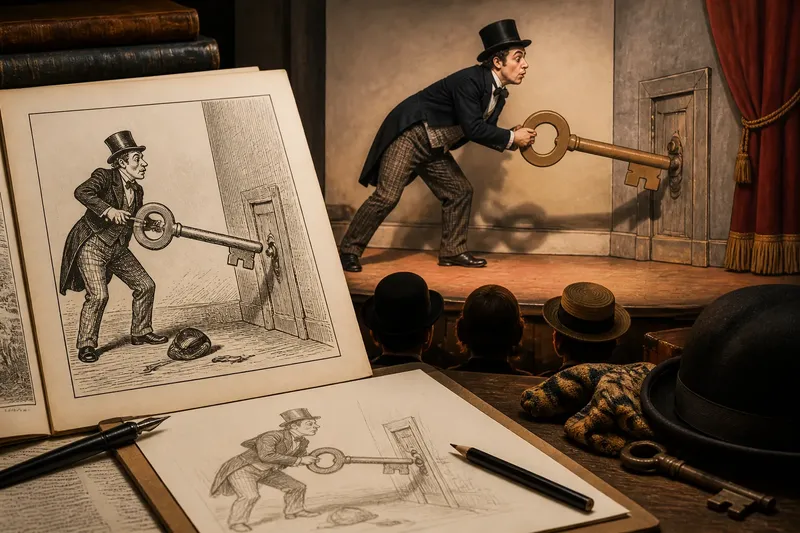
Performance added time and movement. A printed image held one instant; a performer could reveal an object, pause for the audience to notice it, then respond. The audience’s view also depended on distance and sightlines. A small gesture might read on a page but disappear in a theatre, so performers could enlarge a movement or use a more visible prop.
Say a performer in an invented sketch enters with a very large cardboard key and tries it on the wall beside a small painted door. The performer then spots the actual handle and turns it with one finger. The starting point is a door, a large key and the mistaken attempt; the action exposes the mismatch; the expected result is that the audience sees the performer’s misplaced confidence before the scene moves on. On stage, the prop needs to be visible from the audience’s seats, while a printed version could show the same contrast through framing.
Audience questions?
What makes a printed cartoon topical?
A topical cartoon refers to a public event, person or debate that its original readers are expected to recognise. If separated from its publication, it may need a caption or contextual note to remain clear.
Why does a cartoon change in reproduction?
Changes in size, printing quality or cropping can obscure small marks and expressions. If an essential detail disappears, the image may need a clearer shape or a new layout for its new format.
How does stage comedy differ from a printed cartoon?
Stage comedy unfolds over time and depends on performers, props and sightlines. A performer can direct attention with movement and pauses, whereas a reader controls the pace of looking at a printed image.
Can a cartoon work without its original caption?
It can, if the image still communicates the situation and the change in meaning. If the caption supplies necessary context, removing it may leave the joke unclear rather than simply more visual.
Format changes the joke
A cartoon that travels between formats needs more than a familiar subject. Each version has its own demands. A page can hold labels and fine detail; a stage needs shapes that remain readable at a distance. A digital image may be viewed on a small screen, where a crop can remove an important edge of the composition.
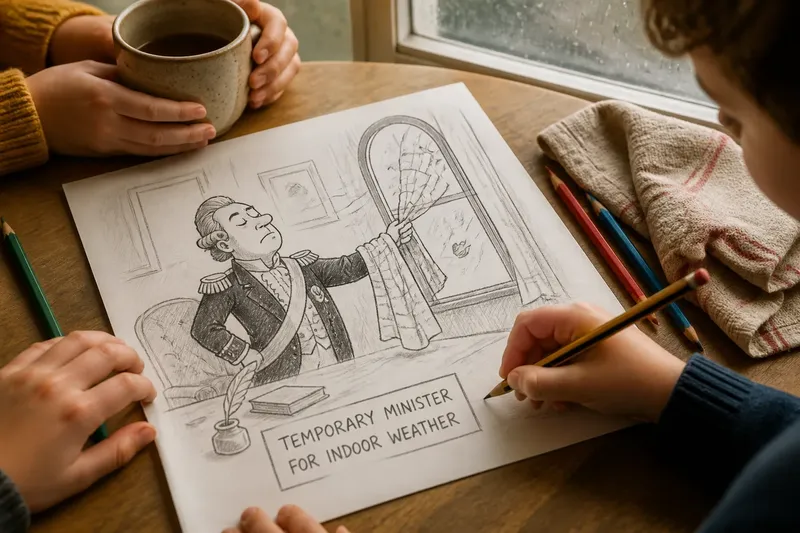
For a practical comparison, imagine adapting an invented cartoon of a person proudly carrying an umbrella indoors while rain falls through a hole in the ceiling. On the printed page, a small puddle may make the leak clear. In a stage version, that detail might be invisible, so the performer could react to a larger falling drop or use a visible bucket; the trade-off is a more pronounced gag in exchange for less subtle detail. The underlying situation remains, but its presentation changes.
Adaptation decisions
When adapting a comic cartoon, list what the audience must notice and decide how the new medium can show it. The following checks pair an observation with a decision, including an alternative action when a detail does not work:
- Check the viewing size: if the main action is clear at the intended size, keep the composition; if it is not, enlarge the action or remove competing detail.
- Check the crop: if the clue remains inside the frame, retain the crop; if it is cut off, widen the frame or move the clue closer to the centre.
- Check the caption: if it adds context the image cannot supply, keep or revise it; if it merely repeats the visible action, remove it or give it a different purpose.
- Check the audience’s sightline: if the prop can be seen from the back of the room, keep its scale; if not, enlarge it or replace it with a clearer gesture.
- Check the timing: if viewers can notice the visual change before the next action, keep the pause; if they miss it, slow the reveal or make the clue more visible.
- Check the historical context: if the reference is recognisable to the intended audience, retain it; if not, add a brief explanation or choose a less context-dependent detail.
The comic cartoon’s path from printed page to live performance was not a simple march towards one ideal form. Print allowed images to circulate and be revisited; performance made visual humour unfold through bodies, objects and pauses. For anyone exploring the comic cartoon’s history, those differences explain why a joke may need to change shape as it travels. Preserve the information the audience needs, then let each medium supply its own way of making that information visible.