The Tiny Switch That Turns a Phrase into a Pun
Learn how to write a pun with a clear first reading and a well-cued second meaning, using sound, context and careful revision to sharpen the joke.
The common mistake in pun writing is to add a second meaning without giving readers a clue where to look; the joke loses its moment of recognition. A strong pun lets the sentence make sense on its surface, then offers a cue that opens another reading. That cue might be a word with two meanings, two words that sound alike, or a familiar phrase used in a fresh context.
How a pun works
A pun works when an expression can be understood along two routes. The first reading fits the situation on the surface. A word, sound or familiar phrase then points towards a second reading. The reader notices how the two meanings fit together, or how they deliberately clash.
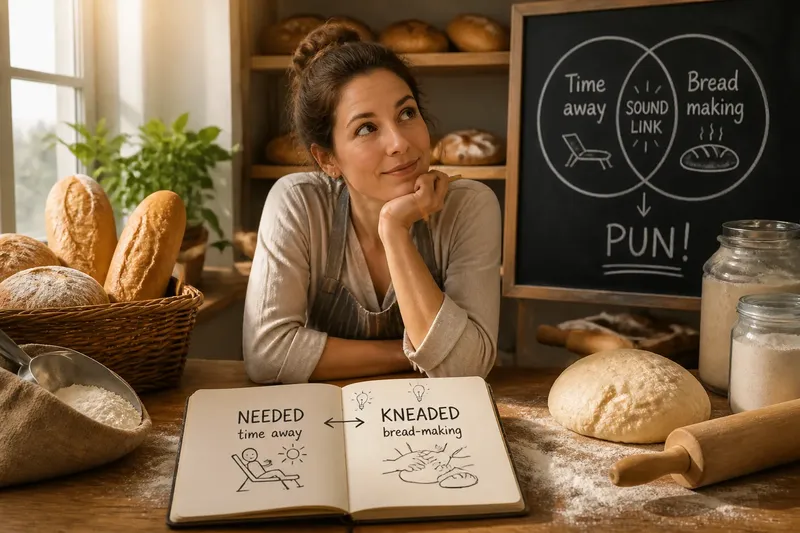
Take the line, “The baker kneaded a break.” In a story about a tired baker, “a break” means time away from work. “Kneaded” sounds like “needed” and also evokes bread-making. The sound link is clear, but the sentence is awkward: “kneaded a break” does not work as ordinary wording. A better pun should preserve a plausible surface sentence as well as the second reading.
For instance, “The baker needed a break, but the dough had other plans” is an ordinary sentence with a bread-making cue, though it is not itself a pun. If you want the sound-alike to carry the joke, the wording must make both “needed” and “kneaded” feel relevant without making the sentence nonsensical. That is the central editing test: does the line still read naturally when the audience has not caught the wordplay?
The moment when a reader recognises the second meaning is sometimes called the “click”. It can be quiet. In a caption, a subtle double meaning may reward a pause; in conversation, the wording usually needs to be easy to catch as it is spoken.
Three pun mechanisms
Before choosing a pun, identify what carries its second reading. The mechanism affects how much context the line needs and whether it will work better aloud, in print or alongside an image.
One word, two senses
A word with multiple meanings can be polysemous when its meanings are related, or a homonym when the same form has unrelated meanings. These labels describe different relationships between meanings; “multiple-meaning word” is a useful plain-language term when that distinction is not relevant.
In “The gardener found the job growing on him”, “growing” connects the garden setting with a gradual change in how the gardener feels about the job. The plant-related reading and the figurative reading support one another.
This mechanism suits a short line where one word can naturally carry both senses. Check that the sentence remains clear if the reader notices only the surface meaning. If the wording becomes confusing without the pun, revise the sentence rather than relying on the reader to repair it.
Two words, one sound
Homophones are different words that sound alike, such as “flour” and “flower”. A writer can use one spelling while adding details that make the other word audible in the reader’s mind.
Imagine a fictional florist writing a sign for a baking-themed display: “Our flower arrangements are rising beautifully.” The shop setting makes “flower” the natural reading, while “rising” and the baking theme cue “flour” and dough. The line remains understandable as a florist’s caption, and its second reading has a specific route into the sentence.
Sound-alike puns can be harder to catch in silent text if nothing points towards the alternate word. A nearby image or a relevant detail can supply that cue, but avoid adding so much explanation that the reader has no connection left to make.
Familiar phrase, new use
An idiom or familiar expression can be turned towards its literal wording. “The gardener got to the root of the problem” uses a familiar expression about finding a cause, while the garden setting makes a plant’s root relevant too.
This approach suits captions, dialogue and headlines because readers recognise the familiar phrase before noticing the extra sense. If the audience does not know the expression, the turn may pass unnoticed. Choose wording your readers are likely to recognise, then make the new context support its literal meaning.
Context gives the cue
Context is the information around a pun that makes its readings available. It may come from the subject, speaker, setting, image or an earlier line. A useful cue points towards both meanings without spelling out the joke.
Too little context leaves the second reading unmotivated. Too much can flatten the effect: if a character explains both meanings before the punchline, the reader has nothing left to discover. Aim for a clear surface reading and one or two details that quietly support the other.
Say you are writing a notice for a fictional bookshop event about detective novels. The line is “A novel approach to a cold case.” The starting point is a bookshop advertising a detective-themed event. You keep “novel approach” because it can mean a new method and refer to a book, while “cold case” signals crime fiction. The result is a sentence that reads as event copy and gives readers a route to the book-related meaning; without the bookshop setting, the line may sound like ordinary promotional language.
In a drawing, a speech bubble with a double-meaning word can sit beside an object that makes the second sense clear. The image should add a clue, not merely repeat the words. If readers have to guess what the object represents, the drawing has added a separate puzzle.
Choosing a pun type
The best form depends on where the joke will appear and how quickly the audience can process it. A spoken exchange can rely on sound, delivery and the immediate setting. A printed caption has to make its cues visible on the page. A headline must remain understandable to someone who sees it without the article beneath it.
- Check the sentence without the second meaning. If it still reads naturally, keep the multiple-meaning word; if it becomes confusing, rewrite the sentence or choose another mechanism.
- Check whether the audience can hear the sound link. If the line will be spoken or has a clear visual cue, consider homophones; if it will appear alone in print, choose a clearer sound cue or another pun type.
- Check whether readers know the phrase. If the idiom is familiar to the intended audience, bend it to fit the scene; if not, use a more widely understood phrase or a different mechanism.
- Check the image’s contribution. If the picture makes the second sense easier to see, keep it as a cue; if it only repeats the wording or introduces confusion, simplify or remove it.
- Check the joke’s setting. If the surrounding topic supports both readings, keep the context; if one meaning has no route into the scene, add a relevant cue or choose another line.
- Check the audience’s vocabulary. If the pun depends on specialist knowledge your readers share, retain the term; if that knowledge is uncertain, choose a familiar word or provide a light contextual clue.
Audience familiarity is part of the context, not a bonus added after the wording is finished. A specialist pun may suit a group that knows the subject. For a broad audience, a familiar word and a clear setting give more readers a fair chance to catch the second meaning.
Questions about pun writing?
How much context does a pun need?
It needs enough for readers to identify the surface meaning and see why another meaning belongs. A setting, nearby object or earlier phrase can provide that cue, but a full explanation usually removes the pleasure of making the connection.
Can a pun work in writing without sounding clever?
Yes. Plain, conversational wording can leave the double reading to do the work. Read the sentence aloud and check whether it sounds natural before the extra meaning comes into view.
What if readers miss the second meaning?
Check whether a cue is present and whether the intended audience knows the word or phrase. If either is missing, revise the context or choose a more accessible switch instead of adding an explanatory sentence.
Should every pun have a punchline?
No. A pun can sit quietly in a title, character name or passing remark. It still needs a clear route to its second reading, but it does not need a separate sentence announcing that it is a joke.
Revising a pun
Test the sentence in the form the audience will meet it. Say spoken lines aloud and notice whether the sound-alike reading is audible. For text, cover any illustration and ask whether the words still offer a plausible first reading; then restore the image and see whether it adds a useful second cue. For example, the florist’s sign should still make sense as a flower-shop caption when the baking cue is less noticeable.
Try removing surrounding words one at a time. If the second meaning disappears when a particular detail is cut, that detail may be doing necessary work. If the joke needs a long explanation to survive, the cue or wording may need another pass.
Rhythm matters too. A switching word placed after unnecessary padding can lose its moment of recognition. Move it towards the end when that creates a small reveal, but keep ordinary word order if rearranging the sentence makes it sound unnatural.
For a quick decision, name both readings in plain language, identify the cue for each, then read the line in its intended setting. If you cannot point to a cue for the second meaning, it may be wishful rather than available. A well-shaped pun lets readers find the small switch for themselves while the sentence still makes sense on the way there.