The Exaggeration Trap: When a Comic Character Gets Too Much
Learn how comic character exaggeration can blur a personality, and use one consistent contradiction to make a character’s behaviour clearer and funnier.
The common mistake in comic character writing is to give a character every amusing quirk that comes to mind. The result can cost the character a clear identity: readers remember a jumble of oddities rather than a person whose behaviour creates reliable comedy. Comic character exaggeration works best when it sharpens one recognisable contradiction instead of adding a new trait at every turn.
Why can too many quirks weaken a character?
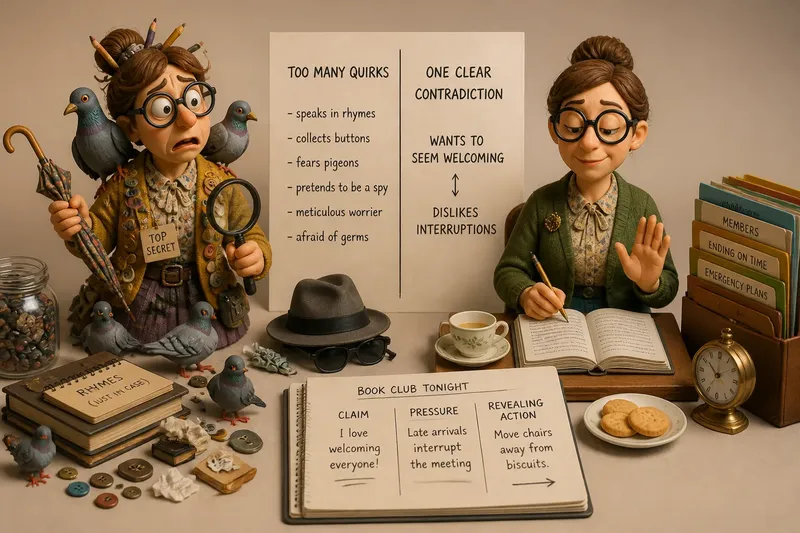
Too many quirks weaken a comic character when they compete for attention. A meticulous worrier who also speaks in rhymes, collects buttons, fears pigeons and lies about being a spy may be vivid on the page, but the reader has little basis for predicting what they will do next. Surprise becomes randomness when each scene draws on a different trait.
Comedy often depends on the gap between what a character wants and what their behaviour produces. If that gap keeps changing, the joke has no steady pressure. A character who longs to seem sophisticated but cannot stop correcting trivial details offers a repeatable source of tension: each attempt at polish exposes the fussiness underneath.
This does not mean a character can have only one feature. People are made of many habits, fears and preferences. The craft decision is which trait drives the comic action, and which details support it. A love of labelled folders might reinforce a need for control; a fondness for obscure trivia might not, unless the character uses facts to avoid admitting uncertainty.
What makes a comic contradiction work?
A comic contradiction is a stable mismatch between a character’s self-image, stated aim or rule and the way they actually behave. It is not merely two unrelated qualities placed side by side. “Brave but untidy” describes contrast, but it does not yet tell a writer how a scene will turn comic.
Try a more active mismatch: a character insists that they are spontaneous, then secretly prepares a backup plan for every casual outing. The contradiction can shape choices, dialogue and reactions. When a friend suggests an unplanned detour, the character may praise the idea while checking whether the route has public toilets and a dry place to sit.
A useful contradiction has three parts:
- A claim: what the character says they value or believe about themselves.
- A pressure point: the situation that tests that claim.
- A revealing action: what they do when the pressure arrives.
The laugh need not come from a punchline. It may come from the precise moment the revealing action contradicts the claim. The audience recognises the mismatch and anticipates its consequences.
How do you choose the central mismatch?
Start with the character’s strongest want, then ask what habit makes that want harder to achieve. The mismatch should create scenes, not just decorate a description. “Wants to be liked, but distrusts compliments” can prompt awkward exchanges. “Has a green coat” usually cannot, unless the coat matters to the character’s behaviour.
Look for a contradiction that can recur without producing the same beat every time. A character who wants to appear generous but keeps score might first offer to help, then mention the favour at an inconvenient moment, then become offended when someone declines. The underlying flaw stays recognisable while the circumstances and consequences change.
Say you are writing a village librarian who prides herself on being welcoming but dislikes interruptions. At a book-club meeting, she might greet late arrivals with warm enthusiasm while silently moving their chairs away from the biscuits so they cannot ask her to fetch anything. The action reveals the contradiction through a small, observable choice. It also gives you room to vary the situation later, rather than relying on another odd hobby.
Keep the character’s goal specific enough to test. “Wants respect” may be too broad to guide a scene. “Wants the committee to treat her as the calmest person in the room” gives you a pressure point: a delayed agenda, a missing teapot or a neighbour who asks an obvious question.
How can a contradiction stay fresh?
Keep the contradiction fixed and vary its expression. A character who wants to look easy-going but needs control can face a family picnic, a shared taxi or a group decision about dinner. The comic mechanism remains legible, but the practical stakes and other people’s responses change.
Change the scale of the consequence, not the character’s basic logic. In one scene, the character’s need for control may cause a mild delay. In another, it may hurt someone’s feelings or derail a plan. Larger consequences should grow from earlier behaviour; otherwise the character can seem to have changed merely to force a bigger joke.
Give supporting characters different ways to respond. One might humour the character, another might challenge them, and a third might exploit the habit. These reactions prevent scenes from becoming a sequence in which the comic character repeats the same action and everyone else delivers the same response.
Restraint also means allowing a trait to go quiet. If every scene calls attention to the contradiction, it stops feeling like behaviour and starts feeling like a cue for the reader to laugh. Let some scenes advance the relationship or the plot without a visible comic payoff. The contrast will be easier to notice when it matters.
What should you cut during revision?
Cut a quirk if it does not reveal the character, complicate their goal or affect another person in a useful way. A detail may be entertaining in isolation yet unnecessary in the story. Ask what would change if it disappeared. If the answer is “nothing”, it may be taking space from the central comic idea.
For each scene, mark the character’s stated aim and their revealing action. If those two parts never meet, the scene may be displaying a collection of funny mannerisms rather than developing the character. You can revise by making the pressure point clearer or by removing an unrelated gag.
Also check whether the character can describe their own contradiction too neatly. A character who announces, “I pretend to be relaxed because I fear losing control,” has already explained the joke. A more human version might insist that the group is free to choose, then keep asking whether everyone has “really” agreed. Let conduct carry what dialogue would flatten.
Keep a short character note beside your draft: “She wants to seem welcoming; interruptions make her protective of her time.” This is not a rule that every scene must obey. It is a compass for deciding whether a proposed quirk belongs to the character or simply appealed to you in the moment.
Which questions help refine the idea?
Can a comic character have several contradictions?
Yes, but one should usually lead the comedy in a given scene. A character may want approval and control, yet those motives can pull in different directions; decide which one is under pressure before shaping the beat. The others can add depth without competing for the reader’s attention.
Should every scene contain a joke?
No. A comic character needs moments of ordinary interaction so their habits feel like part of a life, not a string of punchlines. A quiet scene can also establish what the character is trying to protect, making a later contradiction more meaningful.
How do I know if a quirk belongs?
Ask whether it grows from the character’s want or changes what happens between people. If it only makes the description more colourful, it may be expendable. If removing it changes a choice, conflict or relationship, it has a stronger claim to stay.
Can the contradiction change over time?
It can soften or become more visible as the character responds to consequences. Let that shift emerge through decisions rather than announcing a sudden cure for the flaw. A character who once hid every mistake might eventually admit one, while still showing the old impulse to make excuses.
When revising a comic character, judge each extra quirk by whether it strengthens the central mismatch or distracts from it. Comic character exaggeration becomes clearer when a reader can recognise the character’s claim, see the pressure that challenges it and understand the revealing choice that follows. A single contradiction, tested in varied situations, gives the comedy a dependable source without making every scene feel identical.
Keep one final question beside the manuscript: what does this character hope the room will believe about them? The answer can guide a scene’s comic pressure, while the character’s actions supply the surprise. That balance lets a person remain more than a joke and lets the joke grow from who they are.